How to Regulate in 90 Seconds
A practice-along technique to calm your nervous system in about 90 seconds: four-square breathing.
Quick answer
You can calm your nervous system in 90 seconds using four-square breathing: trace a square with your finger while you inhale, hold, exhale, and hold again, adding an extra deep inhale at the top of each breath. This technique works with your body's natural regulation mechanisms and can be repeated as many times as needed until you feel calmer.
Key takeaways
- Four-square breathing, where you trace a square with your finger while inhaling and exhaling, can help calm an activated nervous system in about 90 seconds.
- Adding an extra, deeper inhale on top of each breath increases the regulation effect of the four-square breathing technique.
- It is common for some people's nervous systems to feel so activated that breathing itself doesn't feel emotionally safe at first, and that reaction is normal.
- The polyvagal theory offers scientific grounding for why breathing techniques like this one help regulate the nervous system.
- The soup technique, learned through TBRI, is a fun way to practice the same smelling-and-blowing breathing pattern with children or in a group setting.
New answers in your inbox
Short, practical, trauma-informed answers, sent whenever we publish.
Common questions
How do you regulate your nervous system in 90 seconds?
What is the soup technique for calming kids?
Why does deep breathing help calm the nervous system?
Full transcript
Read the full transcriptHide transcript
Introduction: Why We Need to Regulate
What’s happening is there’s cues that are going on around us that it’s not safe. Things are not good. And so our nervous system gets more and more activated. Some people use the word triggered. And so because of all that, sometimes we just need to pause and stop and breathe.
How to calm your nervous system in 90 seconds. If you stay to the end, we’ll show you another technique you can use with kids.
So, I’m just going to jump right in because if you’re clicking this video, we’re probably needing help immediately. And if you’ve had a day like I’ve had, I could definitely use this.
This is called regulation. We’re taking our nervous system from here to here.
The Breathing Technique: Four-Square Breathing
Immediately, what we can do — the first good step is to breathe. So I’m going to invite you to do this with me. It’s better if we stand, but in this setting, I’m going to go ahead and stay seated.
We’re going to make a square. It’s called four-square breathing. It’s got a couple of different names, but we just start with our finger and we’re going to make a square. So I invite you to do this with me. And we’re going to inhale and exhale. And inhale and exhale.
Now, I haven’t even started the timer yet, so hopefully we’re already starting to feel a little bit more regulated. But let’s even start a timer. Ninety seconds from now, we’re going to feel better. It’s the magic of oxygen coming in and replenishing our nervous systems in ways that is the coolest.
So let’s do this again. Ninety seconds. Here we go. Inhale. Exhale. Inhale. Exhale.
Adding the Extra Inhale
Now we’re going to take this exercise even a step further. When we inhale, we’re going to do the extra inhale — deeper, to the edge of our breathing — on top of that, which has its own regulation effect.
So let’s do this again with the extra inhales. Inhale with the extra inhale, and then exhale. Inhale with the extra inhale, and exhale.
Why This Works
You may be wondering why this works. That will take a lot of videos to explain. It is magical. And as a person of faith, it makes me really excited to know that God has literally created us to be able to do this in our own body.
What’s happening is there’s cues that are going on around us that it’s not safe. Things are not good. And so our nervous system gets more and more activated. Some people use the word triggered. And you can tell from my nervous system today that sometimes we just need to pause and stop and breathe.
Now for some of us, breathing — we may be so activated and our nervous systems are so heightened that it literally doesn’t feel emotionally safe to breathe. And if that is the case, you are not alone. That is sometimes a common reaction.
So what I would invite you to know is that over time, using this technique of breathing — and there are so many other ways to use the technique — over time, safety starts to return, because what doesn’t feel safe is our nervous system going down. If our nervous system is calming back down, then are we going to be able to find the danger that’s around us? But over time, as we regulate, as we learn how to regulate, it begins to feel like our safe space is learning how to do this technique.
A great theory for you to dig into is called the polyvagal theory. We’re going to include links on this, and I encourage you to understand some of this. There’s a lot of science — sometimes we can say, ‘Yeah, well, of course deep breathing, Meredith, for sure.’ But there is actual science that shows this is a critical way of calming us down, using our body’s natural mechanisms to do so.
More Ways to Regulate
I want to invite us — when we finish this video, feel free to hit replay. Sometimes we need to do this breathing technique, or any breathing technique, over and over and over, and that’s fine. Hit replay and go at it again. That is totally acceptable.
And there are so many other regulation techniques. In other videos, we’ve talked about grounding. There are many other ways to engage our breathing and ways to regulate us. There’s so many different ways, using our body’s natural systems to calm ourselves down.
What I’m giving you today is science and lots of years of experience. I’ve got about 30 years in the mental health field, but we still want to provide articles and ways for you to dig in on this yourselves.
A Technique for Kids: The Soup
As promised, I will show you a way to do this with children. This could be with our own kids, or if you’re in a classroom of some kind, you can use this in a group setting. This is a really fun one with kids, and I’ve seen adults use it too. It’s pretty great. It’s called the soup.
So you make a cup like this — this is your soup bowl. If you want to get really fun with it, you can say, ‘Hey, let’s have some soup.’ And you ask the child, ‘What’s your favorite soup?’ And they say minestrone, or pho, or some sort of soup. And then you say, ‘Oh, that’s great soup. Well, my favorite soup is—’ and then you name yours. For me, I would say crab bisque, if money is no object.
And so we imagine our favorite soup, and then we say, ‘I think we should smell the soup, right?’ And you’re getting really interactive with your kid at this moment. So then we smell the soup, and you just take this deep breath. And then we say, ‘Oh, but the soup is really hot. We should blow the soup.’ Right? So then we blow the soup. And again, you just repeat this — smelling the soup and blowing the soup.
This is a technique that I learned through TBRI. I am a TBRI practitioner, so feel free to follow some of those resources along as well.
Closing Thought
But I hope that this has been regulating for you today. I know that it has been for me. And remember that on this journey, trauma doesn’t get the last word.
Watch next
All episodes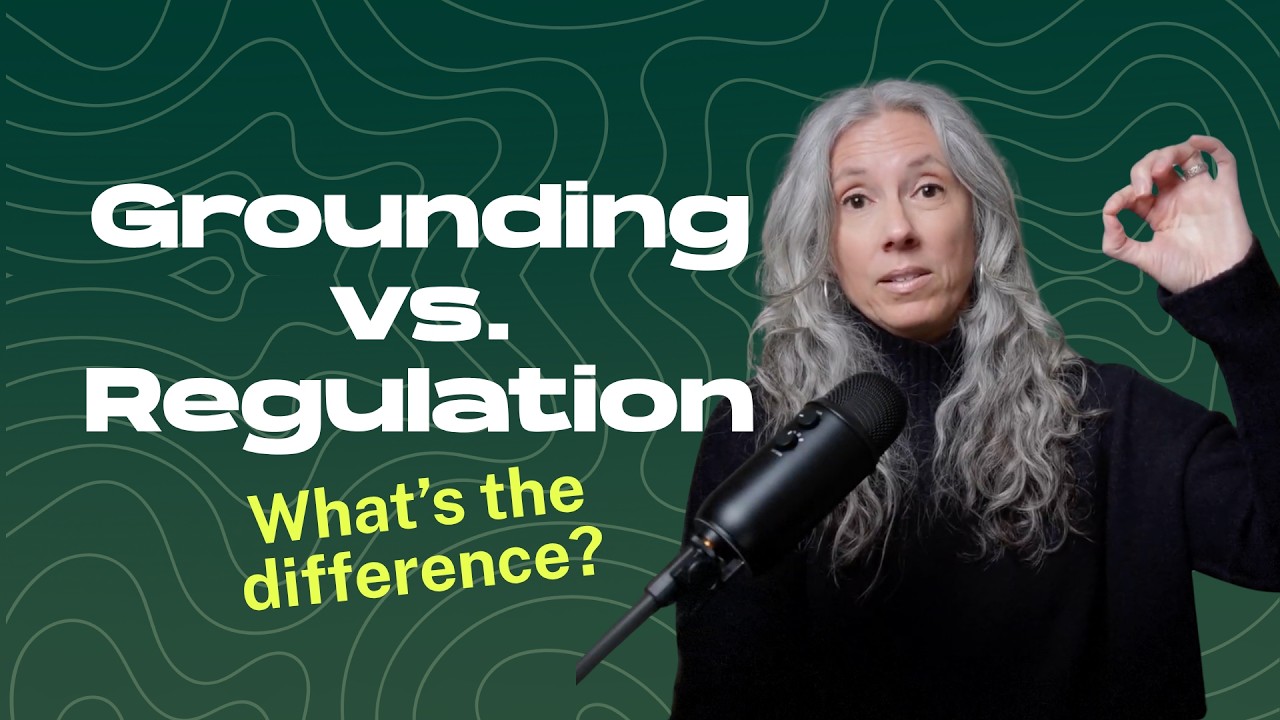
Grounding vs. Regulation: Simple Trauma-Informed Techniques for Anxiety & Stress

Overthinking: Stop the Downward Spiral

5 Things I Wish I Knew About Mental Health 20 Years Ago

Do I Have Childhood Trauma? And What Can I Do About It Now? | Part 2

Can I Actually Heal From Childhood Trauma?

Welcome to Trauma Talk
Keep exploring
Get new answers in your inbox
Short, practical, trauma-informed answers — a new one whenever we publish.
Bringing this to your team?
Start at the Trailhead — a few honest minutes to see where your organization stands.
Start the Trail Marker →